

The ease with which we can now generate software code is astounding. Thanks to LLMs, syntactic logic springs forth in seconds. But let's be clear: generating code and engineering software are two profoundly different beasts. I'm seeing a concerning trend where the sheer speed of generation is being mistakenly equated with quality of delivery. The fundamental differentiator, as always, lies in the specification.
In traditional software development, ambiguity in requirements was a known culprit, leading to bugs, delays, and a mountain of technical debt. In this new era of AI-assisted development, ambiguity isn't just dangerous; it's turbo-charged. If we prompt an LLM without a rigorous, architectural plan – without a clear definition of the business problem we're trying to solve – we're not just creating a bad feature; we're generating legacy code at machine speed. This is precisely the kind of short-term speed for long-term risk trade-off I've cautioned against.
The prevailing approach to using AI in development—often just "prompting"—is frequently devoid of necessary constraints. An engineer asks a model to "write a React component for a user dashboard." The model obliges. It produces code that compiles, renders, and perhaps even looks impressive in a demo.
However, this code is a solitary artifact, utterly lacking context. It knows nothing of our established state management patterns, our enterprise-specific security protocols, our API contract structures, or our error-handling standards. It's the digital equivalent of a "cool demo" that quickly devolves into quicksand when faced with the realities of a production environment.
When we rely on ad-hoc prompting, we're leaning on the probabilistic nature of the model instead of the deterministic requirements of our business. This fundamentally shifts the burden of engineering to the code review phase, forcing our human engineers to untangle a high volume of plausible but architecturally incoherent logic – a task that quickly becomes a long-term drag.
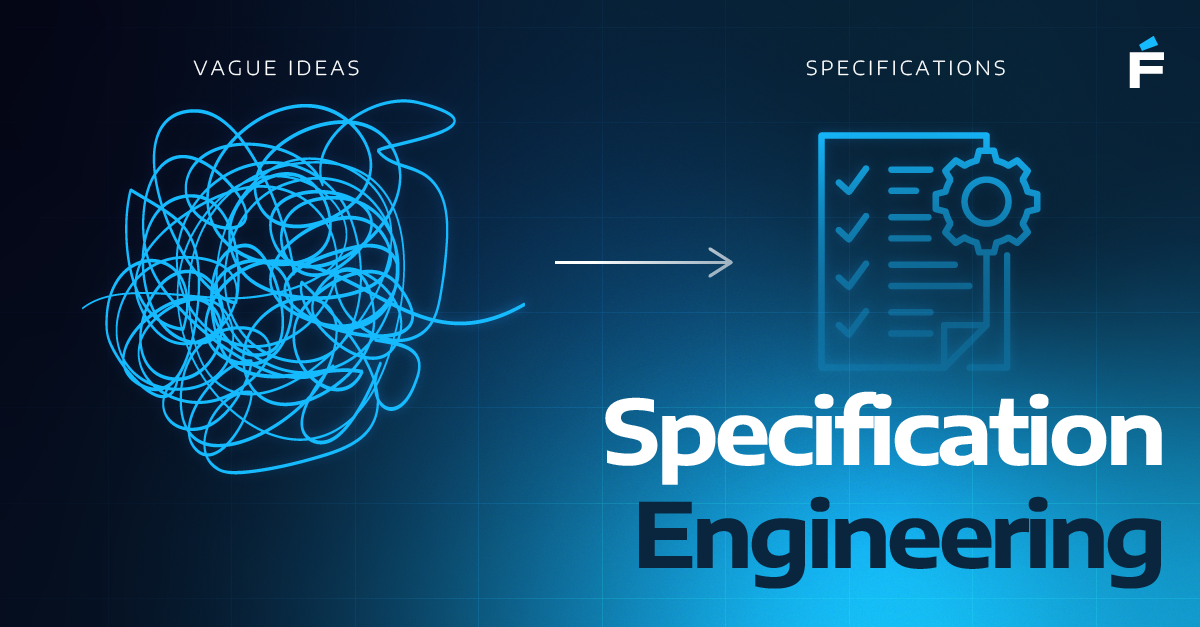
To genuinely generate production-grade code, we must pivot our focus from the output (the code itself) to the input (the specification). We must elevate the specification from a bureaucratic hurdle to the primary engineering artifact. This is where sound engineering practices truly shine in the AI age.
A robust specification for AI generation, one that supports production-ready agents and avoids architectural cracks, must include:
When we provide this level of detail, the LLM's role transforms. It moves from a creative partner attempting to guess intent (and often hallucinating) to a highly efficient translation engine, converting precise requirements into syntax. The quality of the output correlates directly with the precision of the input – a direct reflection of the "garbage in, garbage out" principle that's as old as computing itself.
Let me reiterate a core professional belief: AI does not solve architecture; it ruthlessly exposes the lack of it.
If an organization struggles to define its data models or service boundaries, AI will only amplify that confusion, turning an expensive experiment into a production nightmare. The most effective technical leaders today are those who are doubling down on system design, embracing reference architecture as the foundation. We must define the "what" and the "why" with absolute clarity – addressing the business problem first – so that the "how"—the actual coding—can be automated safely and scalably.
This demands a shift in engineering talent. We need fewer syntax specialists and more systems thinkers. The value is no longer in knowing how to write a loop in Python; the value is in structuring the problem so that a machine can write the loop correctly within the context of a well-architected, distributed system. It's about integration over invention, using existing models effectively rather than building from scratch.
Despite the clear strategic imperative for advanced resilience, organizations face significant practical hurdles that technology alone cannot solve.
While a specification-first approach is essential for quality, it introduces specific challenges that leaders must proactively address:
We are undeniably moving toward a reality where natural language is the interface for computation. However, that natural language must be structured, precise, and constrained. It's not about "ChatGPT is amazing—let's find ways to use it," but rather "What's costing us the most, and how can AI, guided by precise specification, solve that specific problem?"
To truly win in this new paradigm, we must stop viewing prompting as a casual conversation and start viewing it as specification engineering. If we control the specification, we control the quality and mitigate the long-term risks. If we leave it to the model to decide, we are not building software; we are simply accumulating technical debt faster than ever before, trading immediate productivity gains for profound long-term risk.
Let's talk about where you are today and where you want to go - our experts are ready to help you move forward.