

Most AI teams have already proven that models can generate useful output. The friction shows up later—when you ask that output to connect to the systems that actually run the business.
Inventory lives in one place. Customer history lives in another. Policies, pricing rules, approval flows, ticketing, and analytics live somewhere else entirely. The moment you try to wire an LLM into that reality, the “smart” part becomes the easy part. The hard part becomes connectivity, governance, and maintainability.
That is where Model Context Protocol (MCP) comes in.
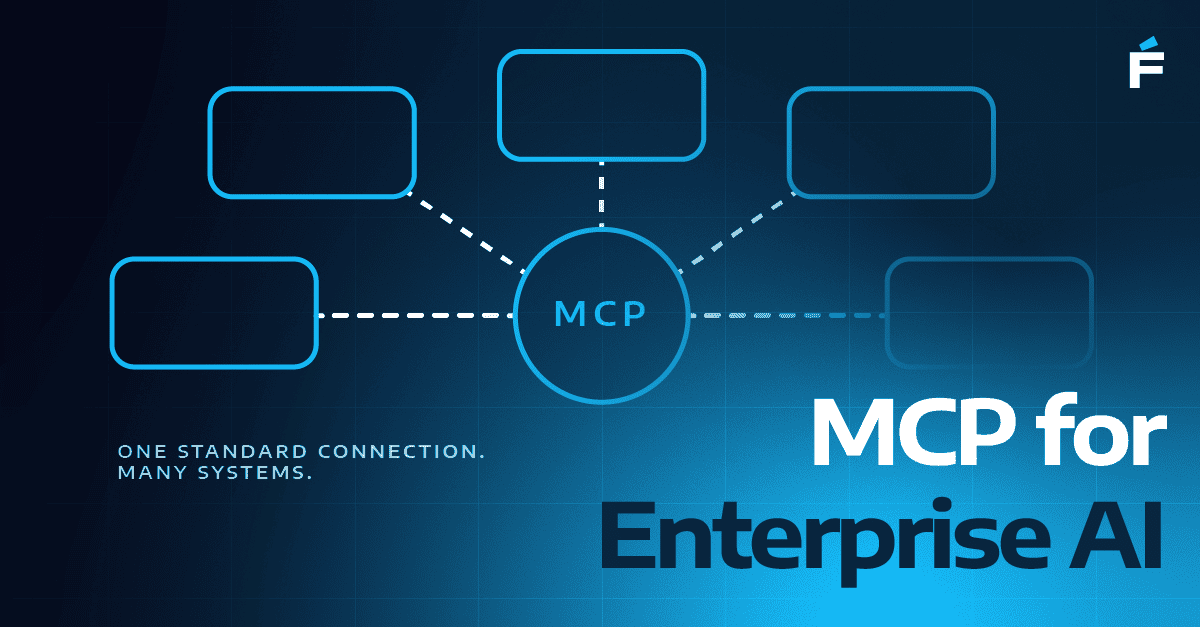
MCP is an open protocol that standardizes how an AI application connects to external systems—tools, data sources, files, and APIs—through a consistent interface. The simplest way to think about it: MCP gives AI applications a predictable “port” for context and actions, so teams stop rebuilding custom integrations for every new workflow.
Most early LLM integrations follow the same pattern:
That approach works for demos. It becomes expensive during iteration.
APIs change. Data models evolve. Permissions tighten. Governance requirements show up late. Over time, integration logic spreads across codebases, and each new AI feature pulls more enterprise coupling into the model application layer. That drives maintenance cost, slows delivery, and increases operational risk.
Teams often blame the model when reliability drops. In practice, reliability collapses when the model operates with incomplete context, inconsistent tool behavior, and unclear access boundaries.
MCP introduces a clean separation of responsibilities through a client–server structure:
Instead of embedding integrations inside the model orchestration code, MCP pushes integration logic into MCP servers. These servers can be versioned, tested, secured, monitored, and reused across multiple AI experiences.
That shift matters for scale. It reduces duplicated integration work, increases consistency across products, and makes changes predictable when systems evolve.
MCP makes capabilities explicit and discoverable through primitives—what servers expose and what clients can support.
Tools
Tools are executable functions the model can invoke: calling APIs, running queries, creating tickets, writing to a database, triggering workflows. Tools tend to carry the highest business value because they connect models to real outcomes.
Resources
Resources provide read-only context: documents, files, reference material, web pages, structured content fetched by URI. Resources help ground the model without turning everything into an action.
Prompts
Prompts in MCP are reusable templates that standardize how the model gets instructed for specific tasks. They behave like managed assets rather than one-off prompt text.
Elicitation
A structured mechanism for requesting missing or ambiguous information from the user at the moment it becomes necessary.
Roots
Scope boundaries that define what the model is allowed to see or operate on. This becomes critical once you bring enterprise data and operational tooling into the loop.
Sampling
A mechanism that allows the server to request model generation through the client—often with user approval as part of the flow.
In the session, Augustine demonstrated a minimal MCP setup:
The demo stayed intentionally lightweight. That was the point. It makes the pattern easy to see:
In a production application, the model chooses which tools to call. In the demo, the client calls them manually. The structure stays consistent.
For small, stable implementations, direct integration can be faster. Everyone in the room acknowledged that.
The payoff starts when the integration surface grows:
MCP becomes a way to standardize the integration layer so the model application stays focused on orchestration and user experience, while the server layer owns the hard work of business logic and system connectivity.
MCP introduces real overhead:
Teams get the most value when they treat MCP servers as production integration assets with clear ownership, testing practices, and monitoring.
For many clients, “agentic” initiatives fail in the transition from prototype to production. Not because the model lacks intelligence. The limiting factor shows up in the integration layer: tool reliability, data access boundaries, and maintainability over time.
MCP provides a practical standard for building that layer. It makes tool connectivity repeatable, improves reuse across applications, and supports the governance requirements enterprise teams eventually need.
If your roadmap includes agents that perform real actions—query systems, generate artifacts, trigger workflows—then you will build a connectivity layer either way. MCP offers a path that reduces rebuilds and improves long-term control.


Let's talk about where you are today and where you want to go - our experts are ready to help you move forward.