

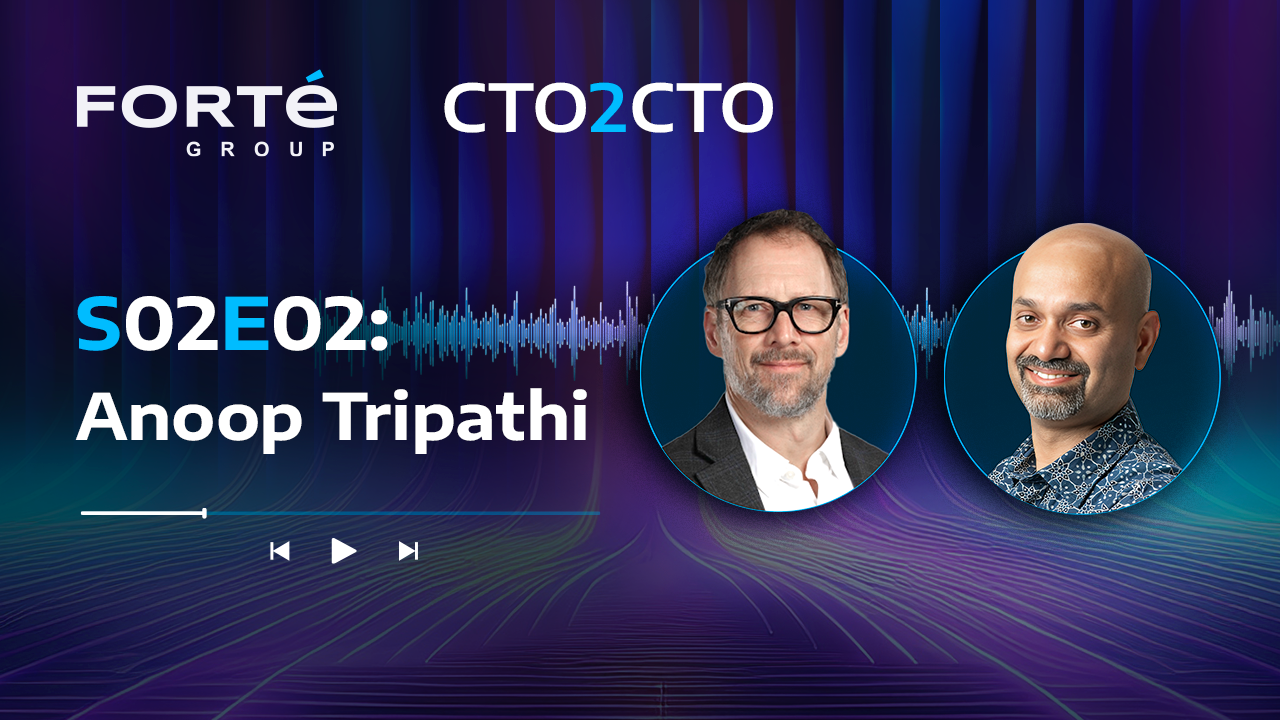

AI is accelerating software development at a pace the industry has never seen. But as Sauce Labs' CTO Anoop Tripathi, makes clear in his conversation with Lucas Hendrich on CTO2CTO, speed alone is not progress.
Anoop’s career spans networking, security, virtualization, and large-scale infrastructure—from early architectural roles to leadership positions at Citrix and now Sauce Labs. Across those experiences, one theme has remained constant: technology succeeds when it reduces friction, not when it adds layers of abstraction.
From VoIP systems to RPA platforms, Anoop has seen entire markets disrupted by one factor: ease of use. Tools that reduce time-to-value consistently outperform those that require specialized expertise just to get started.
That lesson applies even more forcefully in today’s AI-driven environment. While generative AI can produce software at unprecedented speed, the real challenge is maintaining quality, reliability, and trust as volume explodes.
As Anoop explains, AI doesn’t eliminate the need for testing: it multiplies it. More code, written faster, by more people (and machines), creates exponential risk if quality isn’t engineered into the lifecycle.
At Sauce Labs, this reality shapes a long-term vision: automated, AI-assisted testing that spans development, deployment, and production. The goal isn’t to replace engineers, but to remove toil and allow teams to focus on higher-order problems.
One of the most compelling moments in the conversation centers on over-engineering. Anoop challenges the assumption that agentic architectures and automation should be applied everywhere.
AI excels in non-deterministic problem spaces. When systems are already deterministic, adding intelligence often introduces unnecessary fragility. The future, he argues, lies in thoughtful human-AI collaboration, not blind orchestration.
Rather than discouraging AI use, Anoop actively encourages it, even in interviews. The expectation is not manual problem-solving, but sound judgment: understanding when to trust AI output, when to challenge it, and how to turn assistance into production-grade solutions.
AI literacy, architectural thinking, and systems understanding will define successful technologists far more than syntax memorization ever did.
AI is not the end of software engineering, but it is a forcing function. It exposes weak processes, amplifies complexity, and rewards clarity of thinking.
As Anoop puts it, the opportunity ahead isn’t about replacing humans with machines, but about evolving how humans think, design, and build.
Listen to the full episode of CTO2CTO to hear a grounded, experience-driven perspective on where AI is truly taking the software industry.
Let's talk about where you are today and where you want to go - our experts are ready to help you move forward.